Torsional Vibration Calculator
Torsional vibration (TV) is the rotational oscillation of a crankshaft caused by uneven engine firing pulses. Left unmanaged it accelerates fatigue damage across the entire drivetrain — crankshaft, flywheel, gearbox, and beyond.
This interactive calculator visualizes TV behavior for 2–12 cylinder engines. Select your engine configuration, set RPM or run the 60-second sweep, and watch the flywheel animation show velocity variation in real time. Switch to the Campbell diagram to identify resonance crossings — the RPM ranges where excitation orders intersect the system’s torsional natural frequency. Toggle the torsional damper to see how it reduces vibration amplitude and resonance severity.

Stop Guessing. Start Measuring.

Time-based vibration analyzers sample continuously at fixed clock intervals — generating large datasets that require computationally intensive resampling and post-processing before any order content can be extracted. The more data, the longer the wait before you have answers.
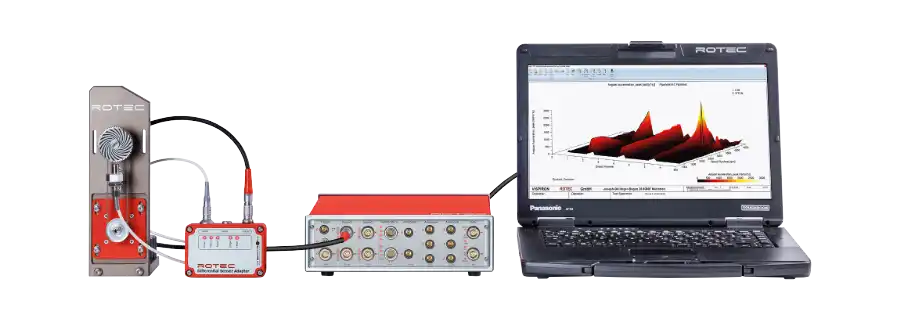
Rotec takes a fundamentally different approach. By sampling angle-equidistant — one measurement per shaft increment rather than per clock tick — the system captures only the data that matters. Smaller files, faster processing, and results you can act on immediately after the test rather than hours or days later.
The analytical advantages are just as significant. While conventional time-based systems smear order content during speed transients, Rotec’s counter-based acquisition delivers clean Campbell diagrams, sharp resonance crossings, and precise order amplitudes from a single coast-down — with no resampling, no interpolation artifacts, and no ambiguity about which order is causing which problem.
Used by engine developers, drivetrain engineers, and NVH specialists worldwide — from motorcycle twins to large bore marine diesels.