GEVS Random Vibration Test Levels and CubeSat Shaker Calculator
We built this because sizing a shaker for CubeSat testing usually starts with a document search and ends in a spreadsheet. Enter your CubeSat, fixture and armature mass, pick your GEVS level, and you get the force, stroke, velocity and peak-g your shaker has to deliver. The GEVS spectra are on the page so you can check our arithmetic. If the numbers point at a system you need, send us the calculation results below and we’ll quote it.

You need this size shaker
The governing requirement across the tests you have ticked, on your total moving mass. Every figure is what the machine has to deliver at the armature.
Sizing, test by test
The same numbers broken out, so you can see which test drives which limit.
Random vibration — GEVS
Low-level sine signature survey
Sine burst — quasi-static load
Test scope
Tick what this campaign runs on the shaker. The sizing above follows your selection.
| Run | Test | Status | Level | Duration |
|---|
Spectrum
GEVS random vibration test levels
From GSFC-STD-7000B Table 2.4-3, generalized random vibration test levels for components of 22.7 kg (50 lb) or less — the level most CubeSat hardware is qualified against. GEVS is a NASA Goddard standard and is in the public domain.
| Frequency | Qualification ASD | Acceptance ASD (−3 dB) | Slope |
|---|---|---|---|
| 20 Hz | 0.026 g²/Hz | 0.013 g²/Hz | — |
| 20 to 50 Hz | rising | rising | +6 dB/oct |
| 50 to 800 Hz | 0.16 g²/Hz | 0.08 g²/Hz | flat |
| 800 to 2000 Hz | falling | falling | −6 dB/oct |
| 2000 Hz | 0.026 g²/Hz | 0.013 g²/Hz | — |
| Overall | 14.1 Grms | 10.0 Grms | — |
Qualification runs 2 minutes per axis in three axes. Protoflight uses the same levels for 1 minute per axis. Acceptance is 3 dB below qualification for 1 minute per axis. For components heavier than 22.7 kg, GEVS allows the plateau to be reduced with mass — check the notes to Table 2.4-3 rather than assuming the 0.16 level still applies.
CubeSat form factors and mass limits
Maximum masses from the CubeSat Design Specification Rev 14.1 (Cal Poly). Most flight units come in well under these, but sizing against the maximum leaves you headroom.
| Form factor | Envelope | Max mass | Max mass (lb) |
|---|---|---|---|
| 1U | 100 × 100 × 113.5 mm | 2.0 kg | 4.4 lb |
| 1.5U | 100 × 100 × 170.25 mm | 3.0 kg | 6.6 lb |
| 2U | 100 × 100 × 227.0 mm | 4.0 kg | 8.8 lb |
| 3U | 100 × 100 × 340.5 mm | 6.0 kg | 13.2 lb |
| 6U | 226.3 × 100 × 366.0 mm | 12.0 kg | 26.5 lb |
| 12U | 226.3 × 226.3 × 366.0 mm | 24.0 kg | 52.9 lb |
A 12U at 24 kg sits above the 22.7 kg ceiling for the GEVS component level shown above, so check whether the mass-reduced spectrum applies before testing one at 14.1 Grms.
Traps worth knowing
This calculator assumes the CubeSat is hard mounted to a fixture: bolted down, rigid, moving with the table. That is the right model for structural qualification of your own hardware, and it is what most CubeSat teams do in house.
It is not the model for a CubeSat inside a dispenser. In a dispenser the satellite sits on rails under a pusher spring, free to move along its long axis, with clearance on the rails and friction at the contact faces. The response is nonlinear, the CubeSat does not see the input the table sees, and effective mass is not simply the sum of the parts. Treating it as a rigid lump will get you a force number that looks fine and a test that behaves nothing like the calculation.
What to do: for sizing a shaker that will test a loaded dispenser, enter the total loaded dispenser mass in the fixture field and use the result as a floor, not an answer — then add margin for the dynamics you cannot model here. For qualifying your own structure, hard mount it and use these numbers as they stand. If you need both, size for the dispenser case, since it is always the heavier one. And whichever you do, control to an accelerometer on the fixture or dispenser base, never on the CubeSat itself.
- Your fixture is the hard part, not the shaker. At CubeSat masses almost any small shaker has the force. What ruins tests is fixture resonance inside the 20 to 2000 Hz band. Aim for a fixture first mode comfortably above 2000 Hz, keep it compact and stiff, and run a bare-fixture survey before the satellite goes on.
- The armature usually outweighs the satellite. A 3U at 6 kg on a 7 kg armature means more than half the force is spent moving the shaker. That is normal and unavoidable, but it is why quoting force against payload mass alone is meaningless.
- Control accelerometer placement decides your test. Mount control accelerometers on the fixture at or near the satellite interface, use more than one and average them if the fixture is not perfectly symmetric, and keep the monitor channels on the satellite for response data only.
- 3σ clipping is not free margin. Controllers usually clip at 3σ, but the true peaks in a Gaussian drive reach further. Size the machine on RMS force for the rating comparison, and check the peak figures above against the shaker’s shock or peak rating.
- GEVS component levels are generic, not your launch environment. They envelope a range of launch vehicles and exist so hardware can be qualified before a ride is booked. Your launch provider or dispenser supplier will impose their own levels, and those take precedence for flight acceptance.
- Quasi-static levels do not come from GEVS. The sine burst limit load in this calculator is whatever your launch provider or dispenser spec requires. Enter it yourself; do not assume a number.
- Sine burst frequency belongs well below your first mode. Around a third of the first mode keeps response overshoot near 13 %, so the CG acceleration tracks the input. Push it up toward two thirds and overshoot approaches 80 %, at which point you are running a resonant test rather than a quasi-static one.
- Shock and thermal vacuum are not shaker work. Pyroshock needs a resonant plate or drop table; TVAC needs a chamber. Neither is sized here.
- Test in flight configuration. Flight batteries at flight state of charge, deployables stowed as they will fly, remove-before-flight items handled per your procedure. Inhibits are usually verified during the random run.
Common questions
- What is the GEVS random vibration level for a CubeSat?
- 14.1 Grms for qualification and protoflight, 10.0 Grms for acceptance, applied in all three axes. The spectrum runs from 20 to 2000 Hz with a 0.16 g²/Hz plateau between 50 and 800 Hz, per GSFC-STD-7000B Table 2.4-3 for components of 22.7 kg or less.
- How long is a GEVS random vibration test?
- Two minutes per axis at qualification level, one minute per axis for protoflight and for acceptance, in three orthogonal axes.
- What size shaker do I need to test a 3U CubeSat?
- Less than most people expect on force, and it depends far more on your fixture and armature than on the satellite. A 6 kg 3U with a modest fixture on a small armature typically lands in the hundreds of newtons to low kilonewtons at 14.1 Grms. Enter your numbers above for the actual figure.
- Is GEVS the same as the SpaceX Rideshare requirement?
- No. GEVS is a generic NASA Goddard component standard used when no specific launch environment is known. The SpaceX Rideshare Payload User’s Guide defines a measured interface environment for that particular ride, with a lower random level but its own quasi-static, sine and shock requirements. Hardware qualified to GEVS generally envelopes the rideshare random level, but that does not satisfy the rideshare verification requirements, which call for testing at integrated payload level.
- Do I need to test my CubeSat inside its dispenser?
- That depends on your launch provider. Many require a dispenser-level test as part of integration, separate from your own structural qualification. The two are different mechanical problems — see the note above on dispenser versus hard-mounted testing.
- Can one shaker do all three axes?
- Usually yes at this scale. Vertical axis runs on the armature or a head expander; the two lateral axes need the article rotated on a fixture or a slip table. Three-axis testing is three separate runs, not a simultaneous one.
About these figures. GEVS levels are taken from GSFC-STD-7000B, a NASA Goddard Space Flight Center standard in the public domain. CubeSat mass limits are from the CubeSat Design Specification Rev 14.1, Cal Poly San Luis Obispo. This calculator is a sizing aid and not a substitute for either document, nor for your launch provider’s requirements, which take precedence.
Force figures ignore fixture dynamics, amplification at resonance, notching, and slip-table friction, all of which move the answer. Random force is quoted RMS, to compare against a shaker’s random rating; sine and burst forces are peak, to compare against the sine rating.
Prepared by PEAK-G LLC — distrubutor of precision test and measurement equipment.
Dynalabs Shakers for CubeSat testing

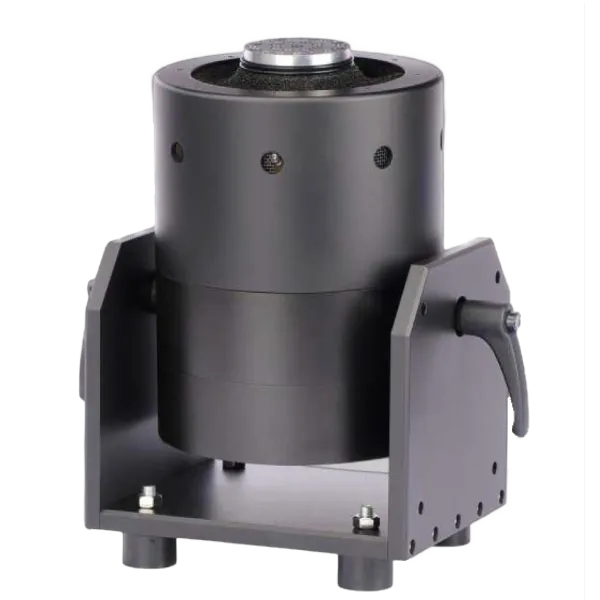
Most of a CubeSat program’s shaker time isn’t spent on the finished satellite. It’s spent on the pieces — boards, sensors, RF modules, hinges, burn-wire releases, deployment mechanisms — shaken individually while a failure still costs a rework instead of a schedule slip, and on characterizing brackets, panels and fixtures against the resonances that matter.
The DYN-PM-440 carries that work and reaches further. With sine and random test modes rated at 440 N, it runs a full 1U at GEVS qualification levels of 14.14 Grms: a 1U on a typical fixture draws around 340 N, and even a 1U at the 2 kg CDS maximum stays inside the rating. In practice the 2.5 kg payload limit binds before force does. The DYN-PM-250 handles 1.55 kg of hardware and fixturing at the same levels, which covers most component and subassembly testing.
Both run 0 to 5 kHz with 20 mm of stroke and 1.6 m/s, on a carbon-fiber suspension with an adjustable trunnion base so you can work vertically or horizontally without a second setup. At under 12 kg they sit on a bench rather than a foundation, and they pair with an SA-400 or SA-500 amplifier.
For 3U and 6U qualification the force climbs quickly — a 3U with fixturing needs around 1.3 kN. Size it with the calculator above and talk to us about the right system.
Simulate Testing with RULA’s vibration controller software
Download RULA Technologies TestUP software to calculate the force, acceleration, velocity and displacement needed for all test modes including sine, random, shock, SRS, sine on random, random on random and more. Select your test type, shaker, test mass and enter the test profile details. The software will calculate the required acceleration, velocity and displacement requirements, and based on the selected shaker system let you know if you’re within the shaker limits. The maximum force is calculated using the test mass vs acceleration values.
This is a free tool. Click the link below to register and download TestUP software today!